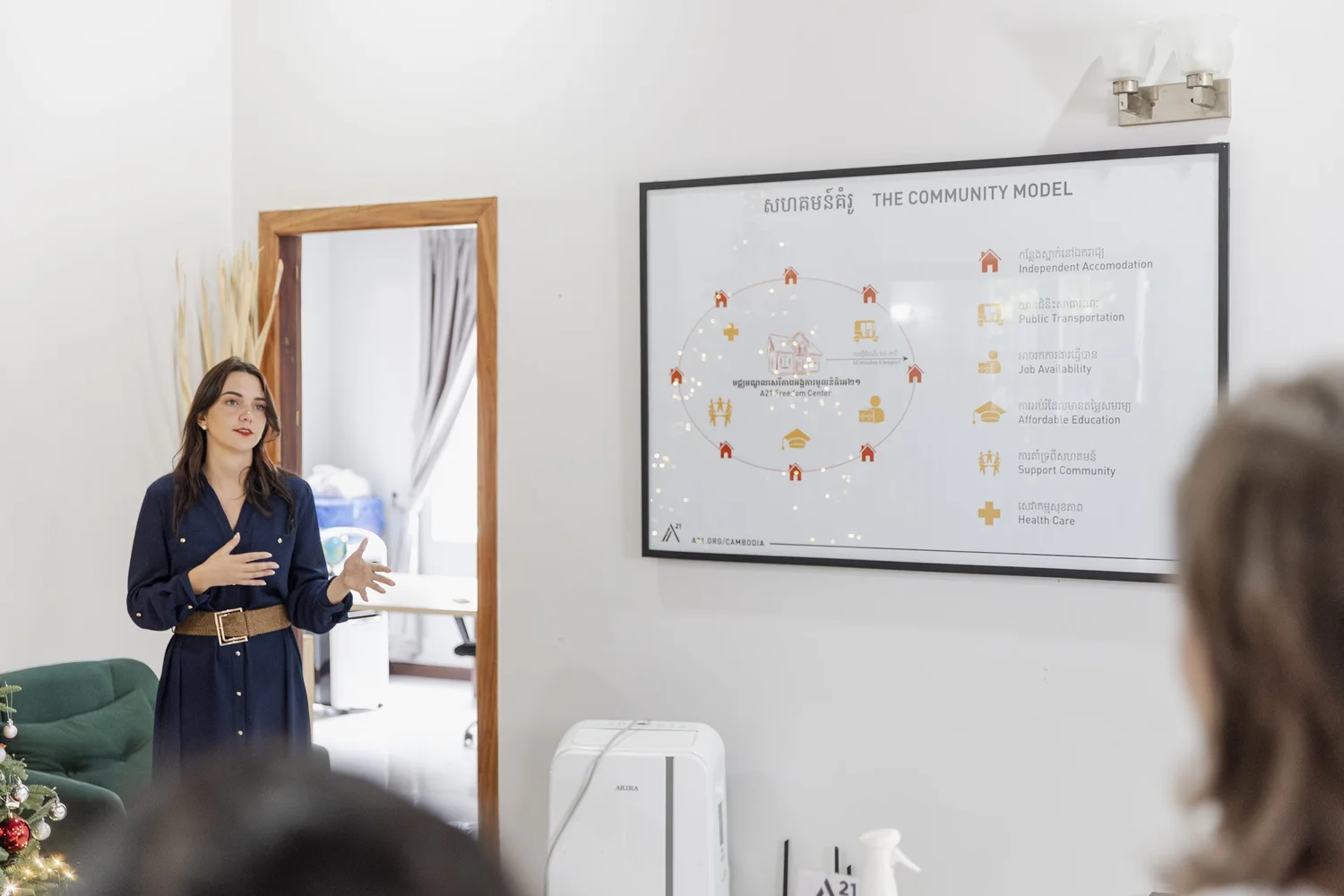
Kristen is Regional Manager for A21 in Southeast Asia, overseeing teams and operations across Cambodia and Thailand, as well as stewarding key partnerships throughout the region. Originally from Canada, she has called Cambodia home since 2017.
What does a typical day look like for you in this work?
Kristen’s role can be as complex as it is demanding—supporting frontline professionals including lawyers, psychologists, advocates, programme leaders, and counsellors who work directly with survivors of exploitation. No two weeks look the same with days possibly involving police operations or court proceedings, facilitating aftercare programmes at the Freedom Centre, joining prevention and awareness initiatives, engaging with government and law enforcement, or coordinating with the global A21 office to ensure a unified response.
What first led you into working in the area of anti human trafficking?
Kristen’s journey into this work began rather unexpectedly. Attending a social justice conference, the topic of human trafficking was explored, and she was stunned by the scale and severity of the issue—its prevalence even in developed nations. It sparked a conviction to learn more, she began researching independently and volunteering with an organisation in her home country that worked in outreach with women in the sex industry. She devoted herself to volunteering and fundraising to support frontline organisations, especially those in Asia, determined to play an active role in the fight against exploitation.
In 2013, Kristen travelled to Cambodia and Thailand for the first time, where she met survivors and the teams serving them on the ground. The experience was deeply confronting, revealing the true human cost of trafficking in ways she had never fully grasped before. “Even though I had done all this research, I really had no idea the extent of human trafficking”, she reflected. Returning home, she carried a grief shaped by the faces and stories she had encountered. Learning more about Cambodia’s history, including the lasting trauma of the Khmer Rouge, only kindled her affection for the country. “Out of poverty, lack of opportunity, being tricked by false job opportunities... people are just longing to live a better life and end up being tricked and forced into labour or sex trafficking, especially children.”
What began as a passion project had become a lifelong commitment. “When I went back to Canada, I cried and I prayed. I asked God, “What can I do to play a bigger role in this?” and from that I actually kept coming back to Cambodia to volunteer. And through building connections and a network I got connected with A21.” Kristen has been working with A21 in Cambodia since its conception, starting as the Development Manager for the Cambodia operations and helping shape its early foundations.
How have you seen lives be transformed by the work that you do?
For Kristen, transformation is not an abstract idea. It is something she witnesses daily, often in quiet, incremental ways that build over time. “At the Freedom Centre, we have survivors under our care coming every single day to have access to support and services. Every single day I’m seeing lives change. Just last year we had 125 survivors under our care... that 125 survivors who were identified, received school scholarships, who received employment, who received medical support they needed, who have a social worker assigned to them to help them on the journey of realised independence.”
Transformation is also seen in the systems that prevent harm before it happens. “Every quarter we have traffickers convicted.” Each conviction represents accountability, but also protection for future victims. “How many people are not going to be trafficked because that one trafficker got convicted?” she asked. “How many people chose not to take a risky job opportunity because we went into their community and trained them in the signs to look out for?”
Beyond rescue and justice, there is also the power of awareness. Kristen noted that even when the team enters communities simply to educate, the impact can be immediate. “Even when we go out into the communities to give presentations about human trafficking or online exploitation, it is very frequently that we receive a disclosure after conducting that presentation.” For her, these moments are a reminder that transformation often begins with knowledge, with language, and with the safety to share.
With the nature of this work, you clearly need to have more than altruistic motives to be dedicated to the mission. What sustains your motivation and helps you remain hopeful?
Kristen was candid about the weight that comes with this work. She shared that when she steps back to look at the scale of human trafficking globally, it can feel overwhelming. “You can feel like we haven’t even made a dent on this issue,” she said. Just as one trafficking trend is addressed, another emerges, often in new and complex forms such as online exploitation. The work can feel relentless, with no clear finish line in sight.
What grounds her, however, is not the size of the problem but the faces of the people directly impacted. “When I come to the Child Advocacy Centre and see children being brought in and then able to receive support,” she explained, the weight shifts. She spoke of children being assigned social workers, placed into safe accommodation, and given access to counselling and care. These moments, though small in the scope of the global issue, are deeply significant.
“For me, that is worth it,” Kristen said simply. Every child protected, every life steadied, every future redirected carries immeasurable value. Hope, for her, is not found in the idea of solving everything at once, but in choosing to remain present to the lives in front of her. “Every life that we have changed is worth it,” she said, “and there are still so many people who need support right now.”
What ways could we as a church come alongside A21, even all the way from New Zealand?
Kristen spoke about the importance of partnership and reminded us that meaningful support is not limited by geography. There are several practical and powerful ways Arise Church and individuals can stand with A21 in their work.
One of the most direct ways is through donations. “We have an incredible team, and you’ve met them,” she shared with me, referring to the qualified social workers, lawyers, and counsellors who work with survivors every day. Financial support allows these teams to remain on the frontlines, equipped and resourced to provide consistent care. “Our goal is to keep giving them what they need to do that work and to continue supporting survivors,” she explained.
Volunteering also plays a vital role, both locally and internationally. Kristen encouraged people to look close to home first. “What anti-trafficking initiatives are in your city or area? See what the needs are and get involved.” She also spoke warmly about mission trips. “We love when people come and visit us. It means a lot to meet those who are supporting us, to share our work, and to help educate you firsthand.”
Another key avenue is education. “Keep learning about human trafficking,” Kristen urged. A21 offers a range of resources, programmes, and short films designed to inform and equip communities. Sharing this information helps build awareness, reduce vulnerability, and empower others to recognise the signs of exploitation.
Finally, she emphasised the importance of prayer. “This is a huge need for us… this work would not be possible without God.” Kristen acknowledged the spiritual weight of the work, describing it as a battle against darkness. Prayer, she explained, sustains the team, protects survivors, and undergirds every part of the mission.
As our conversation came to a close, it was clear that Kristen’s commitment is not driven by urgency or idealism, but by faithfulness over time. She has seen both the weight of the work and the quiet victories that come with it, and she remains present to both. When she said, “I love Cambodia so much. I’m in it for the long-term,” it didn’t sound like a declaration meant to inspire others, but a settled truth shaped by years of simply showing up. It is this kind of long obedience that continues to foster healing, justice, and hope in the lives she encounters every day.